Science

 Thousands of climbing catfish filmed scaling waterfalls
In November 2024, environmental police in Brazil stumbled on an unexpected sight: thousands of orange-and-black bumblebee catfish scaling the slippery rocks behind waterfalls on the Aquidauana River. A week later, a team of Brazilian scientists arrived to document…
Science Magazine ↗ Meet the lab grading MLB’s robo umpire
With high-speed cameras and a “pitch cannon,” researchers are refining the automated ball-strike system about to call its first World Series. Journalist Jon Cohen takes a closer look. Learn more: https://scim.ag/47zvXYm CREDITS: (FOOTAGE) SHANNON BRADLEY; (IMAGES)…
Science Magazine ↗

 See what’s new from the Science family of journals
New tools provide an optogenetic switch for G proteins, how two immune-suppression treatments lower or raise the risk of complications in recipients of stem cell transplants, and a new “digital twin” framework shows that two out of nine…
Science Magazine ↗
 Microbes might be able to planet hop on asteroid shrapnel
Some microorganisms may have little trouble surviving being blasted into space on planetary debris when an asteroid hits. That finding, published in PNAS Nexus, comes from subjecting a particularly hardy species of desert bacteria to a simulation of…
Science Magazine ↗ Footprints may reveal biggest known mammal from age of the dinosaurs
About 130 million years ago, when giant dinosaurs stalked the earth, a mysterious mammal scurried across a damp sand dune in what is today southern Brazil. Mammals at that time were usually small and skittish, the better to…
Science Magazine ↗ These short-lived fish show us how aging works
Can science tell us how long we’re going to live? By recording every moment of the lives of African turquoise killifish, researchers are learning about possible longevity markers for these short-lived fish. Learn more: https://scim.ag/4AY4dtM CREDITS: (FOOTAGE) CHRIS…
Science Magazine ↗ Mathematicians Are The Canary Down The AI Coal Mine
OpenAI claims a swarm of AI agents has solved the Navier-Stokes problem, one of the hardest unsolved questions in mathematics, with a $1 million prize attached. Then it released more than 700 more mathematical manuscripts, including claims touching…
The Rest Is Science ↗ The Gamble That’s Revolutionizing Astronomy | World Science Festival
Building a telescope more than a kilometer under the ice in Antarctica was a gamble. But Francis Halzen had the audacity to try. Decades later, his visionary work has opened a new era of neutrino astronomy, and won…
World Science Festival ↗ See what’s new from the Science family of journals
Uncovering "clocks" of human aging that may predict chronic disease, an AI framework for champion-level drone racing, a "cell-in-a-box" strategy for reversing intervertebral disc degeneration, and revealing how exploding neutrophils drive rare autoinflammatory disorders: check out new covers…
Science Magazine ↗ Will AI Destroy Mathematics? | World Science Festival
What might happen to mathematics, and to mathematicians, when artificial intelligence can solve in hours or days what humans have struggled with for decades or longer. Brian Greene reflects on OpenAI’s release of more than 700 papers, claiming…
World Science Festival ↗ How Jeff Horwitz gained access to Meta’s research
Science Editor-in-Chief Holden Thorp talks to reporter Jeff Horwitz, who shared the 2026 Pulitzer Prize with Engen Tham for their coverage of Meta, which exposed information that was held internally at the company on how Facebook and Instagram…
Science Magazine ↗
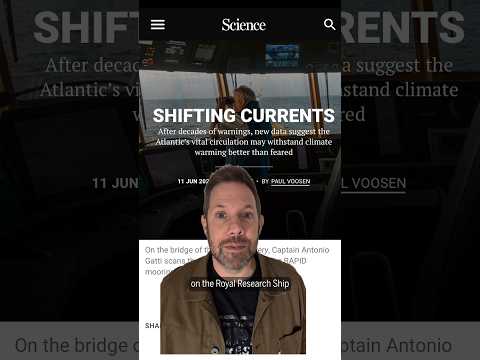 How scientists measure Atlantic currents
After decades of warnings, new data suggest the Atlantic’s vital circulation may withstand climate warming better than feared. Paul Voosen, reporter at Science, explains. Learn more: https://scim.ag/4xq2RX7 CREDITS: (SCRIPT) P. VOOSEN/SCIENCE; (FOOTAGE) NATIONAL OCEANOGRAPHY CENTRE; (MUSIC) C. BURNS/SCIENCE;…
Science Magazine ↗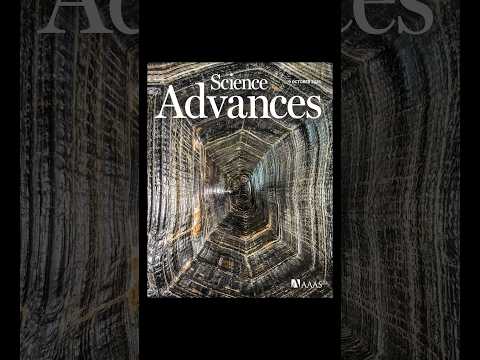 See what’s new from the Science family of journals
The first genome sequence of an 194-year-old Aldabra giant tortoise, fueling T cell inflammation in inflammatory bowel diseases, and repurposing neuroplasticity to defeat cancer: check out this week’s issues of #ScienceAdvances, #ScienceSignaling, and #ScienceTranslationalMedicine. Learn more: https://scim.ag/4hzTTAQ CREDITS:…
Science Magazine ↗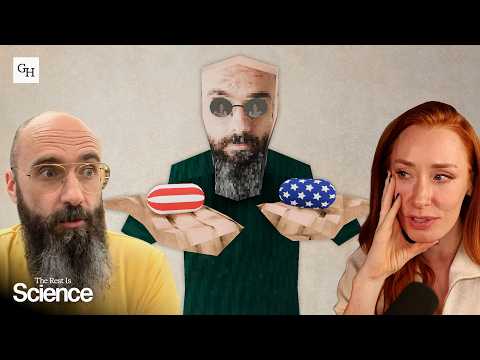 Something Weird Is Going On With Placebos
For the past few decades, something strange has been happening in clinical trials. Painkillers aren't getting worse, but the placebos they're tested against appear to be getting better. In one landmark study, the advantage of pain medication over…
The Rest Is Science ↗ Biology breakthroughs that should have won a Nobel Prize—but didn’t
Major discoveries—including the role of DNA, the biological basis of psychology, and the human genome—missed out on the Nobel Prize in Physiology or Medicine. Learn more: https://scim.ag/4sgadKF CREDITS: (SCRIPT) A. MCWHINNIE/SCIENCE; (IMAGES) NIH GENOME PROJECT; DESIGNCELLS/ISTOCK; PER HENNING/NTNU;…
Science Magazine ↗ What’s the deal with OpenAI’s massive dump of math papers?
On 6 October, the artificial intelligence company OpenAI released more than 700 AI-generated papers presenting results related to more than 370 previously unsolved mathematical problems, including some of the field’s hardest. The massive dump marks yet another landmark…
Science Magazine ↗

 The 2026 Nobel Prize in Physics Explained | World Science Festival
The 2026 Nobel Prize in Physics has been announced. Brian Greene explains the science behind it, and why detecting neutrinos from deep space opens a genuinely new way of observing the universe. Neutrinos were proposed in the 1930s…
World Science Festival ↗

 See what’s new from the Science family of journals
A new topical therapy for scabies, Tibet’s oldest climate record, and light-dependent phosphorylation patterns in the eye of the fruit fly: check out new issues of #ScienceTranslationalMedicine, #ScienceAdvances, and #ScienceSignaling. Learn more: https://scim.ag/4hzTTAQ CREDITS: EYE OF SCIENCE/SCIENCE SOURCE;…
Science Magazine ↗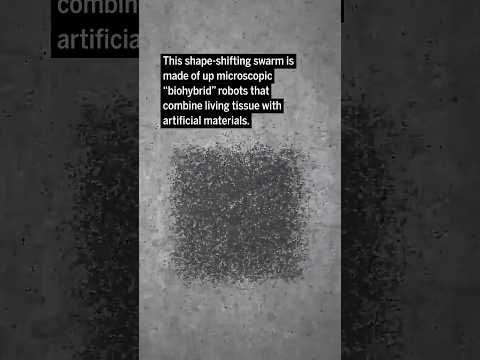 Algae-based microbots swarm like locusts in response to light
Scientists frequently use biology as inspiration for robots, resulting in devices that swim like zebrafish, fly like birds, and grow like vines. Some teams have gone beyond mere inspiration, creating “biohybrid” robots that directly combine living tissue with…
Science Magazine ↗
 Integrating indirect greenhouse gases into climate frameworks
Climate policies are missing something important: indirect greenhouse gases. Learn more: https://scim.ag/4rLSb2E CREDITS: (GRAPHIC) M. HERSHER/SCIENCE; (VIDEO FOOTAGE) RHONDA MILLER/NATIONAL CONSERVATION TRAINING CENTER; (VIDEO PRODUCTION) K. MCLEAN/SCIENCE; (SCRIPT EDITOR) B. WIBLE/SCIENCE #Science #ScienceShorts #Climate
Science Magazine ↗
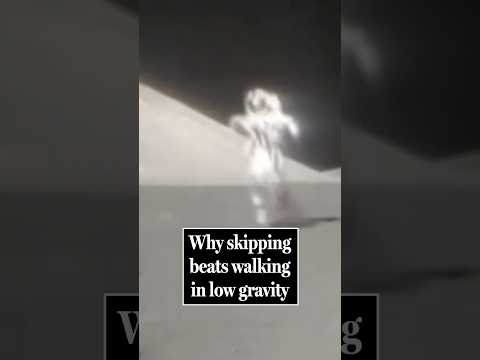 Why skipping beats walking in low gravity
Bungee-jumping mice may reveal why astronauts skip on the Moon. Phie Jacobs, a reporter at Science, explains. Learn more: https://scim.ag/46OWMY1 CREDITS: (FOOTAGE) SANTUZ ET AL./ BIORXIV; (MUSIC) C. BURNS/SCIENCE; (VIDEO PRODUCTION). P. ACKERMAN/ SCIENCE #Biology #Science #ScienceShorts
Science Magazine ↗
 See what’s new from the Science family of journals
Acoustofluidic cryo-EM enhancing imaging, modulating T cell function, and preventing preterm labor: check out new issues of #ScienceAdvances, #ScienceSignaling, and #ScienceTranslationalMedicine. Learn more: https://scim.ag/4hzTTAQ CREDITS: JUN HUANG, YING CHEN, AND COAUTHORS; MOORE ET AL./SCIENCE SIGNALING; JENNIFER L. HERINGTON/VANDERBILT…
Science Magazine ↗ A curious coral reef robot
This autonomous underwater robot can follow sights and sounds to discover coral reef biodiversity. #ScienceTok #STEMTok #ScienceRobotics Learn more: https://scim.ag/4dUhSrL CREDITS: (FOOTAGE) SETH MCCAMMON; (SCRIPT) P. JACOBS/SCIENCE #Science #ScienceShorts #ScienceRobotics
Science Magazine ↗ We Could Just Feed Everyone | We Can Have Nice Things, Actually: #1
Welcome to the first episode of our new podcast series "We CAN have nice things, actually" where we discuss solutions to the many problems the world is currently struggling with. Often you gain more from solving many small…
The Thought Emporium ↗ Science investigation casts doubt on genes hailed for warding off Alzheimer’s disease
Recently discovered genetic variants seem to protect against Alzheimer’s disease, suggesting a path toward a cure. But are their powers believable? Meagan Cantwell, senior video producer at Science, explains. Learn more: https://scim.ag/4gJ4FUx CREDITS: (PHOTOS) FEDERICO RIOS/THE NEW YORK…
Science Magazine ↗ Planned satellite megaconstellations could generate runaway space debris
How much space junk is too much? Science Contributing Correspondent Hannah Richter delves into a recent preprint that suggests swarms of satellites may reach a threshold known as Kessler syndrome. Learn more: https://scim.ag/4yP0Xz0 CREDITS: (IMAGE) EUROPEAN SPACE AGENCY…
Science Magazine ↗